
You have probably heard the formula.
Maybe it was a wedding sermon, a marriage-prep course, a pastor’s counselling office, a podcast hosted by a smiling couple in matching shirts, or a tile shared on Facebook.
The wording varies, but the architecture is always the same: God first, spouse second, children third, yourself last.
Or something to that effect.
For example…

Sometimes, self doesn’t even make the list.
It is implied that to mention yourself at all is to misunderstand the whole point.
Now, it is a beautiful idea on paper.
It promises clarity, sacrifice, devotion, and a kind of moral order that the messiness of real love seems to lack.
It tells us that if we can just get the rankings right, the rest of the marriage will follow.
And, honestly, there is something genuinely good buried inside it…
the instinct that marriage cannot survive on pure self-interest, that something larger than the individual ego must hold a couple together.
That instinct is correct.
But I want to argue, gently and honestly, that this priority list itself, as it is usually preached and practised, is not what produces a happy, lasting marriage.
In fact, decades of marriage research and clinical psychology suggest the opposite: the very people who follow this hierarchy most faithfully are often the ones who arrive in therapists’ offices twenty years in, hollowed out, baffled, and saying some version of I did everything right, and I have nothing left.
And this is not because they were bad spouses.
It is because the model itself contains a hidden flaw, one that only shows up in practice, not on paper or in a sermon.
Let me explain what the research actually says, why this marriage hierarchy fails the way it does, and what a more honest framework might look like.
What this marriage hierarchy is really trying to solve
Before we critique the hierarchy, we should also be fair to it.
The priority list is not arbitrary.
In my opinion, partly why it emerged is due to a real fear, namely the fear of selfishness.
Marriages collapse all the time because two people refuse to give, refuse to compromise, refuse to defer their own needs.
And in my work as a couples counsellor, I have seen that many times.
So, religious and cultural traditions developed a counterweight, namely a moral ranking that demoted the self to protect the marriage bond.
Put yourself last, and the marriage will stand.
But fear was not the only engine driving this idea.
For many Christians, the hierarchy was never primarily about preventing selfishness at all.
It was about devotion.
It is a way of saying, with the structure of your daily life, that God comes first in everything, including how you order your household.
To put God at the top of the marriage list felt like an act of worship, a public and private declaration that this family bows to something higher than its own desires and comforts.
Now, that is a genuinely beautiful impulse.
And it deserves to be honoured as such, rather than reduced to mere rule-following.
But the problem is not the impulse.
The problem is what happens when that impulse gets translated into a rigid domestic ranking system.
Piety becomes a formula.
Devotion becomes a hierarchy.
And somewhere in that translation, a living spiritual instinct gets flattened into a checklist that people are expected to perform, often at considerable cost to themselves, and then feel guilty about questioning.
Let me be clear here: Expressing faithfulness to God through the shape of your marriage is a worthy goal.
But faithfulness and self-erasure are not the same thing, and the fact that they have been conflated so often, in so many churches, is worth thinking about.
So, with that said, the logic of the marriage hierarchy is intuitive and might even sound rational or religious.
For if both partners genuinely put God first, and each other ahead of themselves, you get a virtuous circle of mutual care and ultimately, a successful marriage.
God gets honoured.
Nobody is self-serving, and everyone is giving.
Conflict dissolves into generosity.
It sounds like heaven.
It sounds like a good plan.
The problem, however, is that it does not work that way in actual human beings, and psychology has been quietly documenting why for the better part of seventy years.
Unfortunately, for many well-meaning and beautiful people, intuition and data tell two different stories, no matter how good or even religious it all sounds.
Here’s why…
The differentiation problem: you cannot give what you do not have
In the 1960s and 70s, an American psychiatrist named Murray Bowen developed what is now considered one of the most influential theories of family functioning, called Bowen Family Systems Theory.
At the heart of his work is a concept called differentiation of self, which basically means the capacity to remain a distinct, emotionally regulated person while staying deeply connected to others.
Bowen observed something that has been replicated thousands of times since:
The healthiest couples are not the ones who fuse into each other. They are the ones who can stay close without losing themselves.
Conversely, however, people with low differentiation tend to do one of two things in marriage.
One, they either collapse into the other person’s emotional world, absorbing their moods, abandoning their preferences, deferring every decision, or two, they react against that collapse by cutting off, becoming rigid, or exploding.
Both look, from the outside, like marital problems.
But they are actually problems of the self.
And this is where the marriage hierarchy begins to wobble.
If you systematically place yourself last for ten or twenty years, if you treat your own needs, body, friendships, ambitions, and inner life as the least legitimate item on the family agenda, you are not becoming a more loving spouse.
You are becoming a less differentiated one.
You are slowly erasing the very self that your partner originally married.
And the cruel irony is that the more you erase, the less there is to love.
No wonder, couples in this pattern often describe a strange flatness creeping in.
It’s a kind of…
I do not even know who you are anymore.
That is not because the self-sacrificing spouse failed to sacrifice enough.
It is because they sacrificed the wrong thing.
What John Gottman actually found
Now, if you want to know what predicts a happy, lasting marriage, the gold standard is the work of John and Julie Gottman, who have studied thousands of couples in laboratory settings over four decades.
The Gottmans can predict divorce with startling accuracy from a fifteen-minute conversation, and they have published extensively on what distinguishes the couples who flourish from the ones who fall apart.
Here is what is striking about their findings: the marriage hierarchy is nowhere in them.

Not in the order, not in the ranking, not in the self-erasure.
What predicts thriving marriages is something quite different…
It is the ratio of positive to negative interactions during conflict (roughly five to one in stable couples).
It is the small daily gestures of turning toward your partner when they make a “bid” for attention, a sigh, a comment about the news, a hand reaching across the table.
It is the ability to repair after a fight.
It is emotional attunement, friendship, shared meaning, and the management, not elimination, of perpetual disagreements.
None of these capacities flows naturally from a person who has spent years treating their own inner life as the lowest priority in the household.
They flow from a person who is rested, regulated, has access to their own emotions, knows what they think, and can stay present in a hard conversation without dissolving or attacking.
In other words, they flow from a person who has tended to themselves enough to have a self to bring.
Here’s another way to look at it…
Attachment, oxygen masks, and the slow leak of resentment
Attachment theory tells a similar story.
The work of researchers like Sue Johnson, who developed Emotionally Focused Therapy out of attachment science, shows that the core question partners ask each other, beneath every fight about dishes or in-laws or money, is some version of Are you there for me? Can I reach you?
Secure marriages are built on what Johnson calls accessibility, responsiveness, and emotional engagement.
Now, consider what it takes to be emotionally accessible.
You have to be reachable.
You have to have inner resources to offer.
You have to be able to sit with your partner’s distress without being swept away by it.
None of that is possible if you’re a depleted person.
Let me use a simple analogy…
Anyone who has flown on a commercial airline knows the safety briefing: secure your own oxygen mask before assisting others.
It is not selfishness; it is physics.
An unconscious caregiver cannot care or help.
So, with that in mind, what happens when a spouse spends a decade or two consistently last on their own list?
Two things, almost without exception.
The first is depletion, the gradual loss of vitality, libido, curiosity, humour, and emotional bandwidth.
The second is resentment.
Not loud, dramatic resentment.
The quiet kind.
The kind that leaks out sideways in sarcasm, in lost interest, in unexplained fatigue, in a partner who is technically present but somehow not really there anymore.
Many therapists will tell you that the most common pattern they see in long-term unhappy marriages is not infidelity or abuse.
It is two people who have been so dutiful for so long that they no longer recognise themselves, and they cannot quite figure out why something so virtuous has produced something so empty.
The child-centred trap
Now, a particular version of this problem deserves its own attention, because it harms marriages and children both.
It’s also insidious, and most good parents are too scared to admit how they actually feel (even to themselves), or talk about it honestly and openly.
So it festers while you feel guilty for feeling the way you do.
I’m talking about kids…
Once children enter the picture, the marriage hierarchy often morphs into God, spouse, children, then you, and in practice, the children quickly move to the top.
And this is understandable.
Children are loud, dependent, and adorable.
They make demands you cannot ignore.
But research on family systems is fairly clear that child-centred marriages tend to struggle, and the children of those marriages do not, on average, fare better than children whose parents prioritised their partnership.
And the reason is simple…
The most important thing parents can give their children is not constant attention or sacrificial devotion.
It is a stable, affectionate marriage that the children get to witness.
Kids who grow up watching their parents like each other, flirt, argue and repair, take weekends away, and treat each other as a unit rather than as auxiliary support staff develop a working model of love that will shape their own relationships for life.
But kids who grow up watching two people who orbit only around them, and who barely make eye contact with each other, often leave home with a lurking anxiety they cannot name.
The marriage, it turns out, was the gift to the children all along.
What about the religious dimension?
Now, because the marriage hierarchy is often framed in religious language, it is worth saying something about that explicitly as well.
First off, I am not arguing against faith, devotion, or the idea that something larger than the individual matters in marriage.
However, I am arguing against a particular interpretation of those values that, ironically, may not even be theologically sound.
The very thing you prioritise might actually be asking something else of you entirely.
For instance, consider that the most famous ethical instruction in the Judeo-Christian tradition is love your neighbour as yourself.
That phrasing assumes some functioning self-love is in place.
It does not say love your neighbour instead of yourself, or love your neighbour and despise yourself, BUT, as yourself.
Now, some of you reading this might want to stop me right here and point out that I am leaving something important out.
And you would be right to raise it.
When Jesus was asked about the greatest commandment, he did not give a one-part answer.
He gave two.
First, love God with all your heart, soul, mind, and strength.
Second, love your neighbour as yourself.
However, here’s the issue…
The marriage hierarchy model borrows the first part and turns it into a domestic ranking system, a list with God at the top and you at the bottom.
But that is not what Jesus was constructing.
He was describing a spiritual posture, an orientation of the whole person toward God and toward others, not a formula for how to ration your emotional energy across a household.
So, you can be utterly devoted to God in the deepest theological sense while also sleeping enough, maintaining your friendships, and knowing who you are as a person.
Now, look carefully at the second part of the commandment again.
Jesus does not say love your neighbour instead of yourself.
He does not say love your neighbour more than yourself.
He says love your neighbour as yourself.
That word “as” is doing enormous theological work in that sentence.
It sets self-love as the measuring rod, the standard by which love for others is calibrated and understood.
If you have systematically erased yourself over twenty years of dutiful marriage, you have not only depleted yourself, you have removed the very standard by which the commandment is meant to be measured.
You cannot love your spouse as yourself if there is no coherent self left to measure from.
And consider what it means to love God with all that you are.
That phrase calls for the full engagement of your heart, your mind, your soul, and your strength.
It presupposes that those capacities exist in you, that they are developed, that they are alive.
A person who has spent years treating their own inner life as the least legitimate item on the household agenda is not offering God a fuller or more devoted self. They are offering a depleted one.
Many thoughtful theologians, including writers across both Protestant and Catholic traditions, have argued that the systematic self-erasure preached in some marriage settings, particularly to women, is not the gospel.
It is a cultural overlay borrowed from Victorian sentimentality and a few mistranslated proof-texts, dressed up in religious clothing.
So again, you can hold faith at the centre of your life without making self-neglect the test of your devotion.
In fact, the people in any tradition who have lived the most generous, durable, expansive lives have almost always been deeply rooted in their own personhood.
They had a self to give because they had tended one.
A better framework: integration, not hierarchy
Now, with all of the above said, a valid question then becomes, if the marriage hierarchy does not work, what does?
Again, the data suggest something else.
The research points toward a different shape, not a ranked list, but an integrated ecosystem.
You can think of it as four interlocking circles rather than four rungs on a ladder.
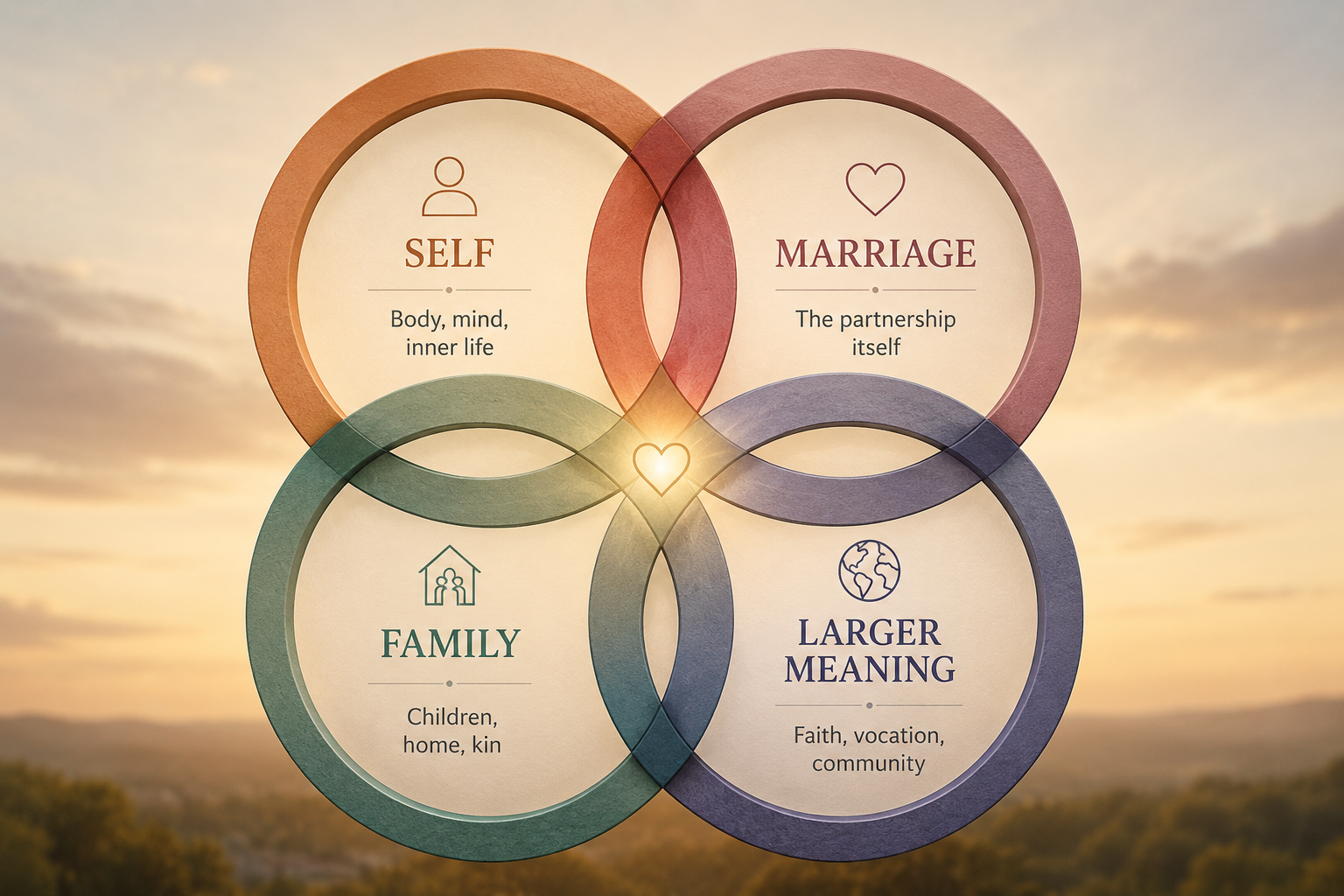
The first circle is your own selfhood, your body, your mind, your friendships, your work, your interests, your spiritual life.
Healthy marriages are made by two people who continue to develop as individuals, not two people who dissolve into a shared blur.
This is what Esther Perel, the Belgian-American therapist, has spent her career arguing:
that desire and aliveness in long-term relationships depend on the partners remaining, in some real sense, two separate people who keep choosing each other.
The second circle is the marriage itself, treated as a real entity, with its own needs, that requires deliberate tending.
Dates that are protected.
Conversations that go beyond logistics.
Repair after fights.
Sexual intimacy that is not the last item on a to-do list at 11 pm.
It’s about a shared sense of where the partnership is going.
The third circle is the family the couple builds together, children, extended family, and the home.
This circle is nourished by the inner two, not the other way around.
Parenting from a healthy marriage looks different from parenting from a depleted one.
The fourth circle, for those for whom it matters, is the larger sense of meaning, faith, vocation, community, and contribution to the world beyond the home.
This circle pulls the whole system outward, gives it purpose, and prevents it from becoming claustrophobic.
But notice that nothing is last here.
Nothing is treated as illegitimate or a guilty indulgence.
The self is not demoted; it is the soil in which everything else grows.
The marriage is not a duty; it is a living thing.
The children are not the centre; they are beloved members of a household whose adults are flourishing.
And very importantly, the larger meaning or religion is not a master to whom everything else is sacrificed; it is the horizon that keeps the rest of life oriented.
Together, these intertwined circles create the possibility for a richer marriage and life together, serving all and not just some.
conclusion
Now, I am not writing this to tell anyone they have been doing it wrong.
Most people who have lived by some version of the marriage hierarchy did so because they were taught it by people they loved and trusted, and because they wanted, sincerely, to be good.
That is not a small thing.
We have to honour that.
The instinct that marriage requires something more than self-interest is correct.
The instinct that we owe our partners and our children real devotion is correct.
But what is worth questioning is the shape of that devotion.
A self-sacrificing marriage and a self-respecting marriage are not the same.
The first looks holier from the outside.
The second tends to last longer, feel warmer, raise healthier children, and produce two people who, thirty years in, still know who they are and still like each other.
The most controversial thing the research actually says is also the most freeing: tending to yourself is not the betrayal of your marriage.
It is one of the most important things you can do for it.
The marriage hierarchy, however well-meaning, often gets this exactly backwards, and the cost is paid quietly, over decades, by people who deserved a better blueprint.
If a marriage is a house, the self is not the basement to be buried and forgotten.
It is the foundation.
Foundations are not glamorous.
Nobody compliments them at weddings.
But every house that has ever stood for fifty years has had one, intact, supporting everything above it.
Including the love.
