
Most couples don’t wake up one morning and suddenly discover that their relationship is in trouble.
It happens gradually.
Conversations become shorter.
Small frustrations turn into familiar arguments.
Affection becomes less spontaneous.
The things that once made us laugh together begin to irritate us.
Somewhere along the way, the person we once couldn’t wait to spend time with becomes the person we struggle to understand.
And perhaps the saddest part is that neither partner necessarily intended for things to turn out this way.
In my work with relationships, one of the things I find particularly interesting is how easily couples become trapped in patterns they both dislike, yet somehow continue to repeat.
Each partner may genuinely believe that things would improve if only the other person would change.
But what if improving your relationship begins somewhere else?
What if the first question isn’t, “What does my partner need to do differently?” but rather,
“What am I bringing into this relationship, and is it helping us become the couple we want to be?”
That question changes the conversation.
Because healthy relationships aren’t built on good intentions alone. They’re shaped by the values we practise, the attitudes we carry, and the small decisions we make, particularly when things aren’t going well.
Let’s explore what that might look like in practice.
1. Stop Waiting for Your Partner to Change
One of the most common traps in struggling relationships is the belief that our happiness depends on our partner doing something differently.
“If only she would listen.”
“If only he would show more affection.”
“If only they would stop being so defensive.”
Sometimes these frustrations are entirely understandable.
Our partners do have responsibilities towards us, and their behaviour genuinely affects our wellbeing.
But there is an important distinction between recognising your partner’s contribution to a problem and surrendering your own ability to influence the relationship.
When we make our willingness to change conditional on someone else’s behaviour, we effectively hand them control over our choices.
Taking ownership means recognising that while you cannot control your partner’s thoughts, emotions or actions, you can take responsibility for your own.
You can decide how you respond to frustration. You can question your assumptions. You can examine whether your communication invites connection or creates distance.
This doesn’t mean accepting blame for everything that goes wrong. Nor does it mean that one partner should carry the responsibility for repairing a relationship alone.
A relationship involves two people, but personal accountability begins with one.
And that one can be you.
Something to reflect on:
- What is one behaviour or attitude you keep justifying because of something your partner does?
- What might change if you took responsibility for it independently of their behaviour?
2. Create Safety Through Acceptance, Not Control
Think about the last time you felt genuinely understood by someone.
Not necessarily agreed with. Just understood.
You could express yourself without being immediately corrected, criticised, dismissed or told why you shouldn’t feel that way.
That experience is incredibly powerful.
Now consider whether your partner regularly experiences that same freedom with you.
Many relationship difficulties are sustained by defensiveness.
One person expresses frustration, the other experiences criticism, and before long, both are protecting themselves rather than listening.
Acceptance offers a different possibility.
It means recognising that your partner is a separate person with their own experiences, emotional needs, interpretations and vulnerabilities.
You don’t have to agree with everything they think or feel.
But you can acknowledge that their experience is real to them.
For example, instead of responding with, “You’re overreacting. That’s not what happened,” you might try:
“I remember that differently, but I can see that it really hurt you. Help me understand.”
Notice the difference.
The first response creates an argument about whose reality is correct.
The second opens a conversation about understanding.
Acceptance also means resisting the temptation to treat every difference as a problem that needs correcting.
Sometimes our partners simply experience the world differently.
And that’s allowed.
Acceptance is not agreement, and it certainly isn’t permission for harmful behaviour. It is the willingness to understand someone without first requiring them to become more like you.
Something to reflect on:
- Does your partner feel free to disagree with you?
- Can they express disappointment or frustration without having to manage your reaction?
3. Have the Courage to Be Vulnerable
Here’s something worth considering.
Sometimes the anger we express is not the emotion we are actually experiencing.
Underneath anger might be disappointment.
Underneath criticism might be loneliness.
Underneath withdrawal might be fear of rejection.
But those emotions are difficult to express because they make us vulnerable.
It’s often easier to say, “You never make time for me,” than to admit, “I miss spending time with you, and sometimes I wonder whether you still enjoy being around me.”
One is an accusation. The other is an invitation into your experience.
Of course, vulnerability carries risk.
Your partner might misunderstand, dismiss or fail to respond in the way you hope.
But emotional intimacy cannot grow when both people are constantly protecting themselves from being hurt.
Someone has to be willing to move beyond the familiar defensive patterns.
That doesn’t mean sharing everything without boundaries or exposing yourself to someone who repeatedly uses your vulnerability against you.
Healthy vulnerability requires trust, and trust develops through consistent, respectful behaviour.
But in a relationship where both partners are willing to participate, being honest about our fears, disappointments, desires and needs can open doors that criticism rarely does.
Something to reflect on:
- What have you been expressing as frustration that might actually be an unmet emotional need?
- Have you communicated that need clearly, without accusation?
4. Learn to Direct Your Frustration Instead of Attacking Each Other
Frustration is a normal part of relationships.
Two people with different backgrounds, expectations, personalities and needs will inevitably disappoint or misunderstand each other at times.
The problem isn’t necessarily frustration itself. It’s what we do with it.
Consider a fairly ordinary situation.
You arrive home after a difficult day. You’re mentally exhausted, perhaps worried about work or finances.
Your partner asks an innocent question, and you respond impatiently.
Suddenly, the conversation isn’t about your difficult day anymore.
It’s about your tone, their reaction, and another unnecessary argument.
The original frustration has been redirected towards the person closest to you.
Learning to recognise this process is an important relationship skill.
Before reacting, ask yourself whether your partner is genuinely responsible for what you’re feeling or whether something else is contributing to your emotional state.
Sometimes our reactions also reveal uncomfortable things about ourselves. And we must pay attention to that.
We might resent a partner’s lack of organisation because we struggle with uncertainty.
We might interpret their independence as rejection because we fear being unimportant.
Or we might experience a simple disagreement as disrespect because being challenged threatens our sense of control.
Not every frustration is projection.
Sometimes a partner really has behaved inconsiderately or crossed a boundary.
But learning to distinguish between what happened, what we interpreted, and what we felt can prevent a great deal of unnecessary conflict.
Something to reflect on:
- When you become irritated with your partner, what else might be influencing your reaction?
- Are you responding to the present situation, or to something deeper?
5. Choose Understanding Over the Need to Be Right
I suspect many of us would struggle to admit just how much energy we spend trying to prove a point.
We explain.
We defend.
We provide evidence. Often with unbendable conviction.
We revisit conversations and remind our partners of what they said last Tuesday.
And sometimes, after all of that effort, we actually win the argument.
But what have we won? Really.
Our partner feels defeated, misunderstood or emotionally distant, and we’re left wondering why proving our point hasn’t made us feel any closer.
There is a difference between standing up for something important and needing to win every disagreement.
Not every misunderstanding requires a verdict.
Sometimes the more useful question is not, “Who’s right?” but, “What are we trying to achieve here?”
Do we want understanding?
Reassurance?
Resolution?
Acknowledgement?
Or do we simply want to be vindicated?
This obviously doesn’t mean abandoning your convictions, tolerating dishonesty or pretending that real problems don’t matter.
But it does mean recognising that a healthy relationship isn’t a courtroom where one person must emerge victorious.
Being right and being connected are not always competing goals, but when winning becomes more important than understanding, connection usually suffers.
Something to reflect on:
- During your last disagreement, were you genuinely trying to understand your partner, or were you preparing your next argument while they were still speaking?
6. Protect Your Partner’s Dignity, Especially During Conflict
One of the clearest indicators of relationship health is how partners treat each other when they’re frustrated.
It’s relatively easy to be affectionate and respectful when things are going well.
The real test comes when we feel hurt, disappointed or angry.
Do we mock each other?
Bring up past failures?
Make personal attacks?
Use sarcasm to communicate contempt?
Threaten to leave simply to gain the upper hand?
Or can we disagree without making the other person feel small?
Every relationship develops an emotional atmosphere.
I call it our Relationship Climate, and it’s at the heart of my couples work.
In some relationships, partners feel encouraged, appreciated and valued.
In others, they become increasingly cautious, defensive or reluctant to express themselves.
We contribute to that atmosphere through our everyday interactions.
Compliments, encouragement, appreciation and recognition are not superficial gestures.
They communicate something important: “I see you, and you matter to me.”
Equally, criticism that attacks someone’s character rather than addressing a particular behaviour can slowly undermine their sense of safety within the relationship.
Compare these statements for instance:
“You’re so selfish. You never think about anyone except yourself.”
And:
“When we make plans without discussing them together, I feel overlooked. I’d like us to make those decisions as a team.”
Both express dissatisfaction, but only one protects the dignity of the person receiving it.
A useful principle is to challenge the behaviour without attacking the person.
And agree that disagreements will never become opportunities for humiliation, intimidation, manipulation or threats.
A disagreement should not automatically place the future of the relationship on trial.
Something to reflect on:
- How does your partner generally feel about themselves after a difficult conversation with you?
- And how do you feel after one with them?
7. Rediscover the Friendship Beneath the Relationship
Before many couples became partners, spouses, parents or co-managers of a household, they were friends.
Well…hopefully.
They were curious about each other.
They talked about things that mattered and things that didn’t.
They laughed.
They discovered shared interests.
They enjoyed one another’s company without every interaction revolving around responsibilities or problems.
Over time, however, the practical demands of life can begin to dominate the relationship.
Children, careers, finances, schedules and endless responsibilities slowly consume the space where friendship once lived.
Eventually, the relationship can become very efficient at managing life but remarkably poor at enjoying it.
This is why I believe friendship deserves much more attention in relationship counselling.
Friendship is not simply about having things in common.
It involves mutual interest, affection, respect, goodwill and the freedom to be yourself in another person’s company.
It’s being able to laugh together, express disagreement without fear, celebrate each other’s achievements and genuinely enjoy spending time together.
It also requires balance.
I often encourage couples to consider three important dimensions of their relationship: Power, Affect and Respect (PAR).
Power concerns how influence, decisions and responsibilities are shared. Affect concerns emotional warmth, care and connection.
Respect concerns whether each person’s dignity, individuality and needs are valued.
When these are balanced, friendship has room to flourish.

When one partner consistently dominates, affection disappears, or respect deteriorates, the relationship often begins to feel less like a partnership and more like an obligation.
And rebuilding friendship doesn’t necessarily require an expensive holiday or elaborate romantic gesture.
Sometimes it begins with putting the phone away, asking a genuine question, taking a walk together, or remembering how to have a conversation that isn’t about what’s wrong.
Something to reflect on:
- If you removed the children, bills, household responsibilities and daily routines from your conversations, what would you and your partner still enjoy talking about?
8. Stop Expecting Love to Sustain Itself
There is a romantic idea that if two people genuinely love each other, the relationship should somehow take care of itself.
But love, however genuine, doesn’t automatically produce a healthy relationship.
Our intentions have to become behaviours.
We might love our partner deeply while remaining emotionally unavailable.
We might care about their happiness while repeatedly dismissing their concerns.
We might value the relationship while investing almost no deliberate energy into maintaining it.
Love becomes meaningful when it finds expression in how we treat one another.
That means being proactive rather than waiting until something goes wrong.
It means noticing opportunities for connection.
Following through on commitments.
Initiating difficult conversations with kindness.
Expressing affection.
Showing appreciation.
And making time for each other before the relationship becomes another crisis demanding our attention.
It also means recognising that long-term relationships will experience difficult seasons.
Conflict, disappointment and periods of emotional distance don’t necessarily mean that a relationship has failed.
What matters is whether both partners remain willing to respond constructively and repair the connection when it becomes strained.
And perhaps most importantly, we need to stop confusing the absence of conflict with the presence of a healthy relationship.
Two people can live together for years without arguing and still feel profoundly disconnected.
The goal isn’t simply to fight less.
It’s to build something worth protecting.
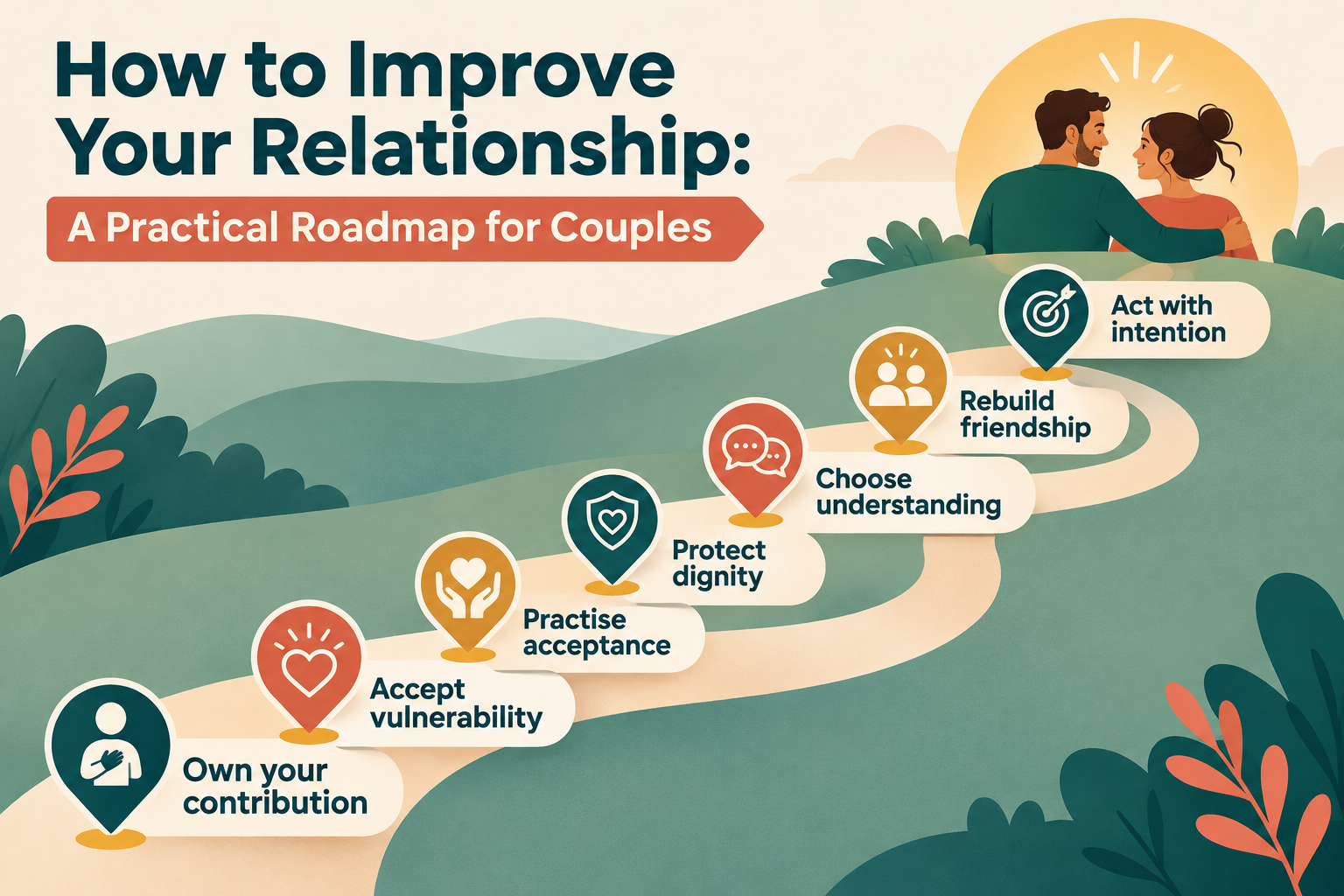
A Four-Week Roadmap for Improving Your Relationship
Now, understanding all those principles above is one thing.
Practising them, however, particularly when old habits are deeply established, is another.
So, rather than attempting to transform everything overnight, consider spending the next four weeks making small, deliberate changes together.
Week 1: Start With Yourself
Focus: Accountability and self-awareness
For the first week, pay attention to your own responses rather than monitoring your partner’s behaviour.
Notice when you become defensive, impatient, critical or withdrawn.
Consider what triggers those reactions and what might be happening beneath them.
At the end of each day, ask yourself:
“What did I contribute to the emotional atmosphere of our relationship today?”
Choose one habitual response you want to change.
It might be interrupting, raising your voice, withdrawing during disagreements or assuming negative intentions.
The goal isn’t perfection.
It’s awareness and personal responsibility.
Week 2: Make Honest Conversations Safer
Focus: Acceptance, vulnerability and communication
Set aside 20 minutes, at least twice this week, to talk without distractions.
One person speaks while the other listens, without interrupting, correcting or immediately offering solutions.
Discuss how you’ve been feeling in the relationship, what you’ve appreciated recently, and what you might be missing.
Practise expressing feelings and needs rather than accusations.
Instead of asking, “Why don’t you ever listen to me?” try, “I’ve been feeling disconnected, and I really miss having conversations where we both feel heard.”
The listener’s task is not to defend themselves. It’s to understand.
Before responding, try summarising what you heard and asking whether you’ve understood correctly.
Week 3: Rebuild the Friendship
Focus: Affection, appreciation and enjoyment
This week, shift some attention away from what isn’t working and towards what you genuinely value about each other.
Each day, identify one thing you appreciate about your partner and tell them.
Create at least one opportunity to spend time together without discussing work, children, finances or relationship problems.
Do something simply because you enjoy it.
Ask each other what you used to love doing together and what you might enjoy exploring now.
Remember, the person you’re with today isn’t necessarily the same person you first met.
Stay curious about who they’re becoming.
Week 4: Change How You Handle Conflict
Focus: Respect, repair and shared commitment
Identify one recurring disagreement and examine the pattern surrounding it.
Who usually initiates?
How does the other respond?
What causes the discussion to escalate?
How does it typically end?
Rather than immediately trying to resolve the issue itself, agree on one change to the way you approach it.
Perhaps you’ll stop interrupting.
Perhaps you’ll take a 20-minute break when emotions become overwhelming, with an agreed time to resume the conversation.
Perhaps you’ll replace criticism with direct requests.
Or perhaps you’ll begin difficult conversations by acknowledging the other person’s perspective before explaining your own.
At the end of the week, ask each other what has changed, what still feels difficult, and what you’d like to keep practising.
Now, importantly, these four weeks aren’t a magic solution.
They’re simply an opportunity to begin creating different experiences with each other again, to reset your relationship climate so that you can start experiencing higher levels of happiness, health, and intimacy.
With that in mind, here are…
Five Questions Worth Asking Each Other Regularly
Make space for a short relationship check-in every week or two.
- Connection: Have you felt emotionally close to me recently? When did you feel most connected, and when did you feel distant?
- Understanding: Is there something you’ve been trying to communicate that I haven’t properly understood?
- Respect: Have my words or actions made you feel dismissed, criticised or unimportant?
- Friendship: Are we still finding opportunities to laugh, enjoy each other’s company and have fun together?
- Responsibility: What is one thing each of us can do differently to make our relationship feel healthier?
The purpose of these questions isn’t to evaluate who is performing better.
It’s to create a regular opportunity for openness, honesty and shared responsibility.
And remember, listening to an uncomfortable answer without immediately defending yourself may be one of the most valuable things you can offer your relationship.
The Relationship You Want Begins With the Relationship You’re Creating
I think one of the more uncomfortable truths about relationships is that we can become so preoccupied with what we’re not receiving that we stop paying attention to what we’re contributing.
We want affection but respond with criticism.
We want honesty but become defensive when our partner tells us something difficult.
We want respect but sometimes speak to each other in ways we would never speak to a friend.
We want closeness but retreat into silence when things become uncomfortable.
None of this necessarily means we don’t love each other.
It means we’re human, with our own histories, insecurities, expectations and emotional habits.
But being human also gives us the capacity to reflect, learn and change.
You don’t need to get everything right.
You don’t need to agree on everything.
And you certainly don’t need to pretend that difficult feelings or unresolved problems don’t exist.
What you do need, if both partners are willing, is a commitment to becoming more intentional about how you relate to each other.
Less blame and more responsibility.
Less defensiveness and more curiosity.
Less competition and more cooperation.
Less waiting for love to happen and more actively expressing it.
Perhaps the question worth taking into your next conversation isn’t whether your partner is making you happy.
Perhaps it’s this:
“Are the ways we’re treating each other creating the kind of relationship we both want to live in?”
And if the answer is no, what are we willing to do differently?
Because improving a relationship rarely begins with one grand gesture.
More often, it begins with two people making a series of small, conscious decisions to stop moving away from each other and start finding their way back.
An important note: These principles are intended for relationships where both partners can participate safely and voluntarily. Taking ownership does not mean accepting abuse, intimidation, coercive control or repeated violations of boundaries. In these situations, safety and appropriate professional support must come before relationship repair. One partner can change their own behaviour, but cannot single-handedly create a healthy relationship.
