
I’ve recently received several counselling enquiries from people struggling with conflict and communication issues in their relationships.
It’s hardly surprising, given how often communication is identified as one of the most important ingredients of a successful relationship.
However, whenever someone tells me that they and their partner need to communicate better, I find myself wondering about something else first.
What is happening between these two people that makes communicating so difficult in the first place?
After all, most of us know that we shouldn’t interrupt someone when they’re speaking, raise our voices unnecessarily, make personal attacks or dismiss another person’s feelings.
Yet, knowing these things doesn’t seem to prevent us from doing precisely that when we’re sufficiently frustrated, hurt or angry.
Why is that?
I would argue that, in many instances, what presents as a communication problem is at least partly a problem of emotional regulation.
And unless we address that, learning new communication techniques can become the relational equivalent of rearranging the deckchairs on the Titanic.
We might be doing something useful, but we’re overlooking a considerably bigger problem.
The relationship climate in which communication takes place
Those familiar with my work will know that I approach relationship improvement primarily from the perspective of what I call our Relationship Climate.
Essentially, my argument is that our priority as couples should be to create and maintain a healthy, happy and intimate relational environment.
Think of it as cultivating the soil in which things like communication, vulnerability, affection, friendship and sexual intimacy can grow.
Consider, for instance, how differently you might receive constructive criticism from someone you trust and genuinely believe has your best interests at heart, compared to someone around whom you feel perpetually judged.
The words could be identical, yet your experience of them could be entirely different.
The climate in which an interaction occurs, therefore, matters.
Now, consider how much of that climate is influenced by our ability to manage ourselves emotionally.
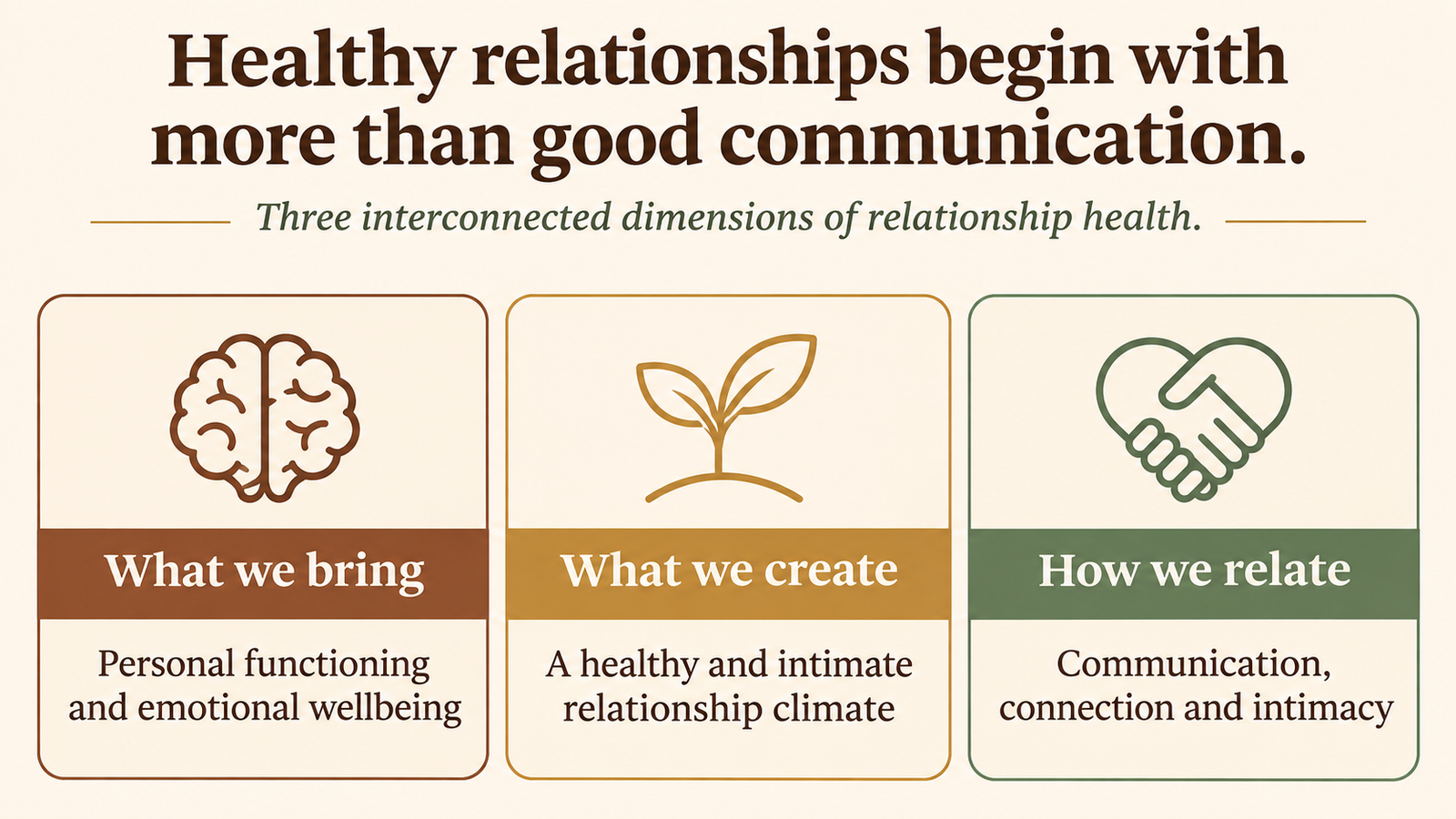
If expressing disappointment regularly results in an argument, raising a concern is met with defensiveness, or being vulnerable exposes someone to ridicule, it makes sense that a partner might eventually become reluctant to communicate openly.
They might even be accused of being a poor communicator when, in reality, they’ve learnt to be cautious about communicating with us.
This brings us to a somewhat uncomfortable but important question:
What is it like to be in a relationship with you when you’re not at your best?
Not when you’re rested, happy, feeling loved and getting what you need from the relationship, but when you’re exhausted, disappointed, anxious or feeling misunderstood.
Because those experiences also contribute to the relationship climate your partner lives in.
What is emotional regulation, exactly?
Emotional self-regulation, or emotion regulation as it’s commonly referred to in psychological research, describes the processes through which we influence the emotions we experience, their intensity and duration, and how we express them.
In practical terms, it’s our ability to manage what happens within us and how we subsequently behave towards the world around us.
Importantly, emotional regulation isn’t about becoming an emotionally neutral person who remains unaffected by everything.
Nor is it about suppressing your feelings, pretending that something doesn’t bother you or maintaining the peace at all costs.
In fact, research by psychologists James Gross and Oliver John (2003) found that habitual emotional suppression was associated with poorer interpersonal functioning and well-being, whereas cognitive reappraisal, which involves reconsidering how we interpret an experience, was associated with more favourable outcomes.
There’s a considerable difference between feeling angry and expressing that anger destructively.
You can be angry with your partner without humiliating them.
You can feel disappointed without withdrawing affection to punish them.
You can feel anxious about something without attempting to control everyone around you.
And you can communicate all these emotions honestly while remaining respectful.
The objective, therefore, isn’t to stop feeling things. It’s to develop a greater capacity to choose what we do in response to what we feel.
Why emotional regulation is so important in relationships
In a 2014 study published in the journal Emotion, researchers Lian Bloch, Claudia Haase and Robert Levenson examined married couples over a period of 13 years.
Among their findings was that wives’ ability to recover from negative emotional experiences during marital conflict was associated with greater marital satisfaction for both partners.
Constructive communication also helped explain some of the longer-term benefits.
Interestingly, this suggests that the ability to recover emotionally may help make constructive communication possible, rather than better communication being the entire solution in itself.
More recently, a study involving 275 couples entering therapy found that difficulties with impulse control, emotional awareness and access to emotional regulation strategies were associated with poorer relationship satisfaction.
None of this means that we should expect one partner to carry the emotional responsibility for the entire relationship.
It does, however, highlight how something we might consider an individual psychological skill has implications for the people closest to us.
And perhaps nowhere is that more apparent than in our own homes.
I’ve become increasingly aware in my own life of how differently I can experience exactly the same situation depending on my physical and mental state.
Something I can respond to with patience and perspective in the morning might irritate me considerably after a demanding day.
The circumstances haven’t necessarily changed, but my capacity to deal with them has.
If I’m unaware of that, I can easily end up attributing my entire emotional experience to someone else’s behaviour and responding accordingly.
Consequently, someone I love ends up dealing with frustration that only partly has anything to do with them.
I suspect many of us are guilty of doing this.
Which raises the question of what we can practically do to become better at managing ourselves.
Nine emotional regulation skills worth developing
Drawing on established emotion regulation research and a framework outlined by psychologist Dr Tchiki Davis, here are nine skills worth developing, particularly within the context of our relationships.
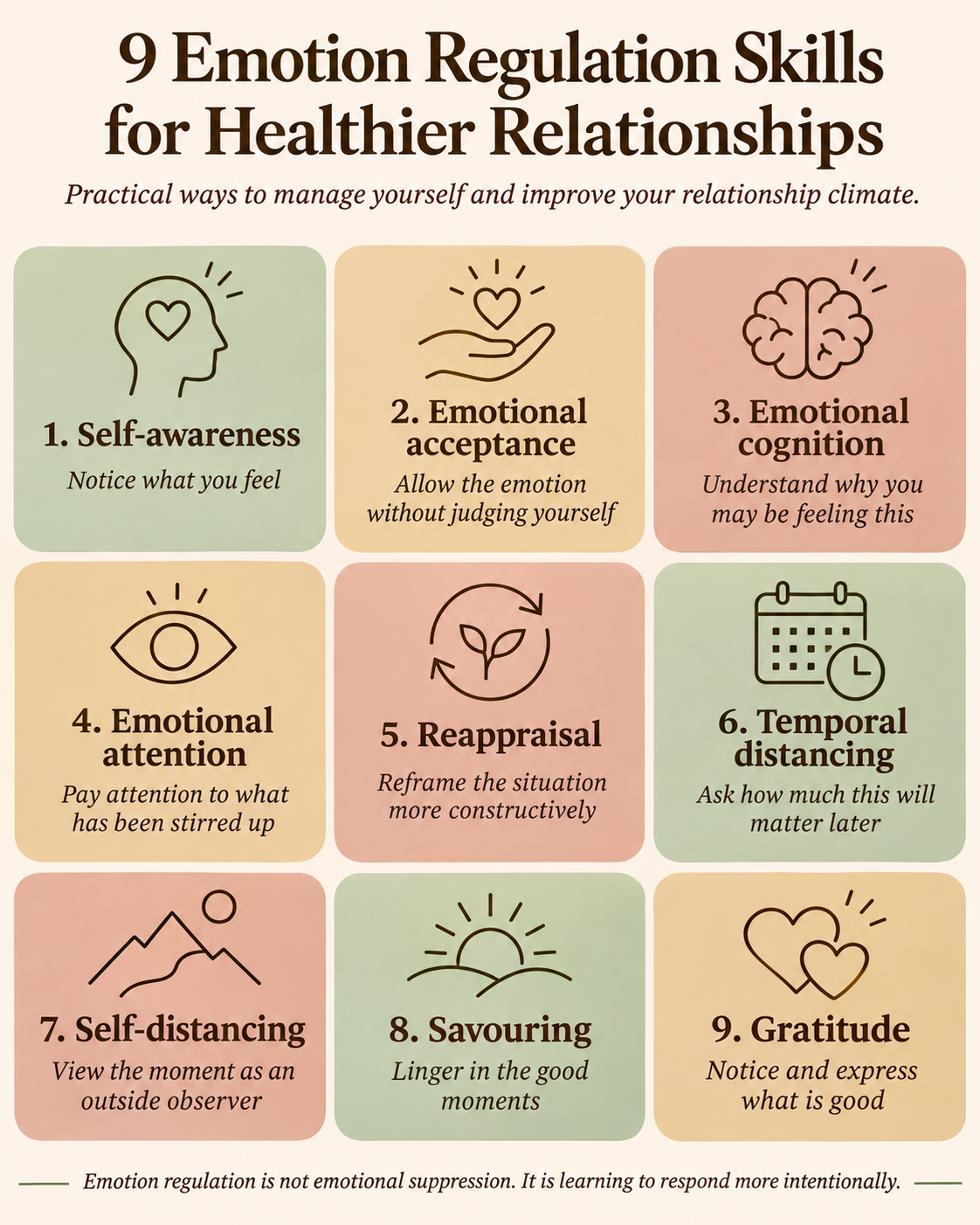
1. Become more aware of what you’re feeling
It’s difficult to manage an emotional experience you’re not aware of having.
Start paying attention to the early indications that something is happening within you. Perhaps your jaw tightens, your breathing changes, you become impatient, or you feel an increasing need to prove a point.
Then try putting a name to the experience.
Interestingly, research into affect labelling, the process of putting feelings into words, suggests that identifying an emotion can itself influence how we process it.
The next time you become irritated with your partner, consider asking yourself whether you’re genuinely angry or whether you’re feeling rejected, overwhelmed, embarrassed or afraid.
The distinction matters because each of those experiences might warrant a very different response.
2. Accept your emotions without judging yourself for having them
Sometimes we make our emotional experiences considerably more difficult by fighting with ourselves about having them.
We feel jealous and then criticise ourselves for being jealous. We experience anxiety and become frustrated because we believe we should be stronger than that.
Research by Ford and colleagues (2018) found that accepting rather than judging our thoughts and emotions was associated with better psychological health and less negative emotional reactivity to everyday stressors.
Acceptance doesn’t mean endorsing every feeling or acting upon it.
It simply means acknowledging what’s already happening within you rather than wasting additional energy arguing with its existence.
3. Become curious about why you feel the way you do
Once you’ve identified and acknowledged an emotion, explore what might be informing it.
Suppose your partner disagrees with you about a parenting decision, and you become disproportionately upset.
Is it really the disagreement that’s bothering you?
Or does their disagreement touch upon an existing insecurity about your competence as a parent?
Sometimes what we’re reacting to is not merely what’s happening in the present but what we’ve come to associate with it.
Understanding that distinction can help us avoid making our partners entirely responsible for emotional experiences shaped by our own histories, fears and expectations.
4. Become more deliberate about where you direct your attention
When we’re frustrated with someone, it’s remarkably easy to start mentally compiling evidence against them.
We recall previous disagreements, overlooked promises and other occasions on which they disappointed us.
Before long, we’re no longer responding to one particular incident but to an entire catalogue of perceived offences.
Instead, practise broadening your attention.
What else is true about your partner? What else is happening in their life? What might you be overlooking because you’re currently upset?
This isn’t about ignoring legitimate concerns.
It’s about ensuring that your current emotional state doesn’t become the only lens through which you view the entire relationship.
5. Reconsider your interpretation of what’s happening
Cognitive reappraisal involves revisiting the meaning we’ve attached to an experience.
Imagine your partner arrives home unusually quiet and seems uninterested in talking to you.
You might immediately interpret their behaviour as rejection, indifference or evidence that something is wrong with your relationship.
But what if they’ve simply had a particularly difficult day?
The point isn’t that the more charitable interpretation is necessarily correct. The point is that your initial interpretation isn’t necessarily correct either.
One of the more valuable habits we can develop in relationships is becoming curious about things we’re tempted to feel certain about.
Sometimes asking a genuine question can save us from an entirely unnecessary argument.
6. Put the experience into a longer-term perspective
Temporal distancing involves considering a present experience from the perspective of your future self.
Research into temporal distancing suggests that this change in perspective can help us manage emotional responses to everyday stressors.
In the heat of a disagreement, consider asking yourself how important this particular issue will be tomorrow, next month or five years from now.
Some things will remain important and deserve your attention.
Others, however, might reveal themselves to be relatively insignificant compared to the damage you could cause by insisting on winning the argument.
7. Practise looking at yourself from the outside
Imagine watching a recording of your most recent argument with your partner.
- What would you notice about your tone of voice, facial expressions, body language and willingness to listen?
- Would you consider your behaviour reasonable if you were watching someone else behaving that way?
- Bonus question: Is what you notice about yourself in that moment the type of person you believe you are and profess to be?
This technique, known as self-distancing, is supported by research into psychological distancing as an emotion regulation strategy.
Temporarily adopting an observer’s perspective can help us see aspects of an interaction that are difficult to recognise when we’re emotionally immersed in it.
8. Allow yourself to enjoy the good moments
Emotional regulation isn’t exclusively concerned with managing difficult emotions.
It also involves cultivating positive emotional experiences.
Think about how easily a pleasant evening with your partner can disappear from your awareness, whereas an unpleasant argument might occupy your thoughts for days.
Savouring involves deliberately spending more time experiencing and appreciating those enjoyable moments.
Research into relational savouring suggests that recalling positive experiences of closeness can enhance positive emotions.
So, when you find yourselves laughing together, enjoying a quiet coffee or having an unexpectedly good conversation, give yourself permission to linger there for a while.
Not every moment needs to be spent working on the relationship.
Some moments simply need to be enjoyed.
9. Cultivate and express gratitude
Over time, it’s easy to become so familiar with what someone contributes to our lives that we stop noticing it.
Yet research by Algoe, Gable and Maisel (2010) found that everyday experiences of gratitude between romantic partners predicted greater relationship connection and satisfaction the following day.
There’s something quite different about living with someone who regularly notices what you’re getting wrong compared to someone who also notices what you’re getting right.
Make an effort to become the latter.
What to do when you feel yourself becoming emotionally overwhelmed
Of course, reading about these skills and implementing them during an argument are two very different things.
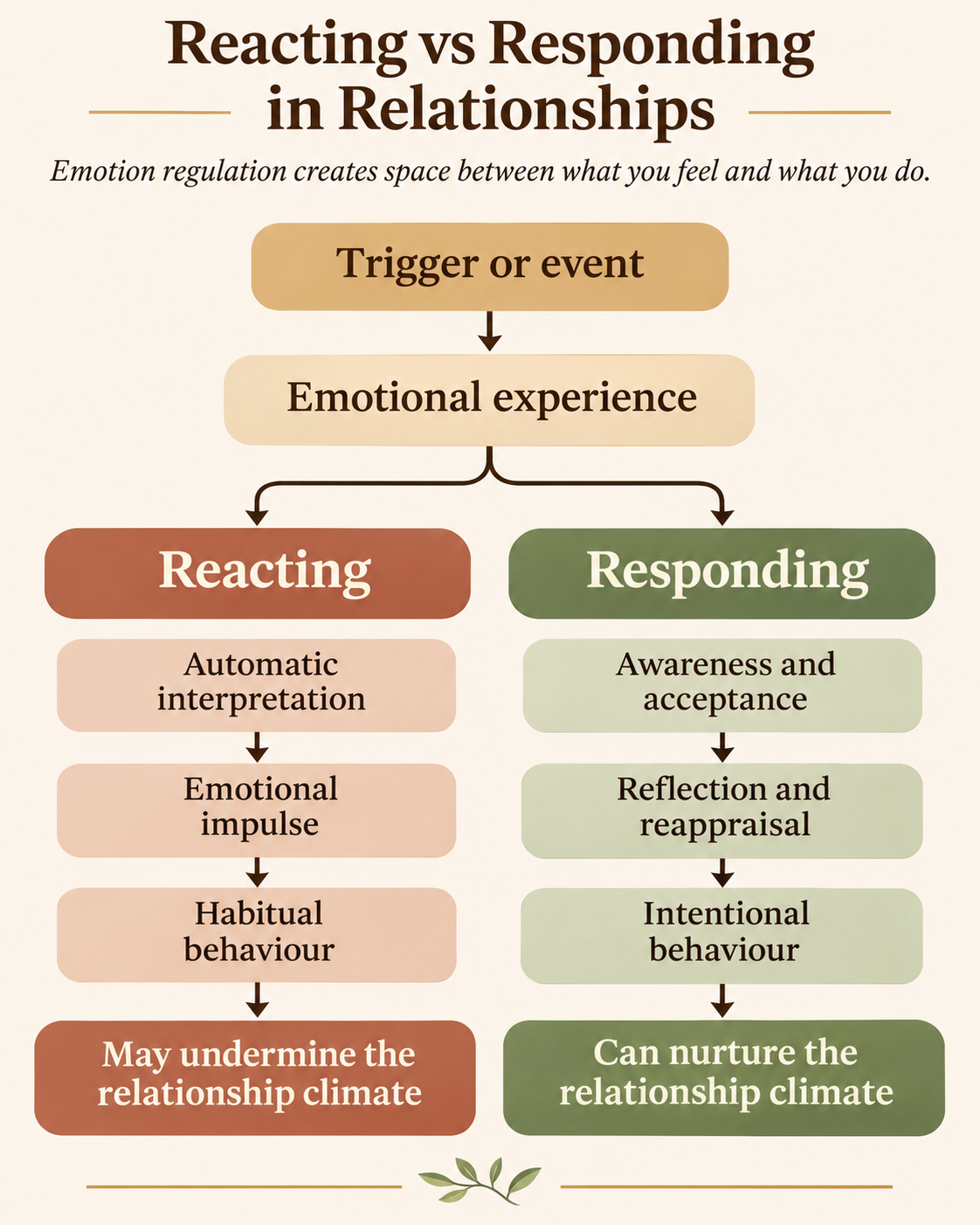
Rather than expecting yourself to master all nine immediately, consider practising the following the next time you feel yourself becoming emotionally reactive:
- Notice what’s happening within you.
- Identify what you’re feeling without immediately blaming your partner for it.
- Question the interpretation you’ve attached to the situation.
- Consider what your intended response might contribute to your relationship.
- If necessary, ask for some time to settle yourself before returning to the conversation.
That last point is particularly important.
Taking some time to regulate yourself isn’t the same as shutting your partner out.
Communicate that you need a break and agree on when you’ll return to the discussion. Then make sure you do.
And if you’ve already reacted poorly, take responsibility for that behaviour and attempt to repair the damage without making your apology contingent upon your partner apologising first.
Become someone with whom it is easier to have a relationship
I think one of the more challenging aspects of personal growth is coming to terms with the fact that we can genuinely love someone and still behave in ways that make being loved by us difficult.
Our intentions and the experiences we create for others don’t always align.
We might desperately want closeness while behaving in ways that discourage vulnerability.
We might want our partners to be honest with us but struggle to manage ourselves whenever their honesty makes us uncomfortable.
And we might spend considerable energy trying to get the people around us to change, overlooking how much could improve if we became better at managing ourselves.
That doesn’t mean accepting mistreatment, tolerating abuse or taking responsibility for another person’s harmful behaviour.
Nor can one emotionally regulated person single-handedly create a healthy relationship.
But it does mean recognising that our emotional habits are part of the relational environment in which the people we love have to live.
So, perhaps before asking how your partner could communicate better with you, consider asking yourself whether your responses make it easier or harder for them to do so.
- Are they able to disagree with you without fearing the consequences?
- Can they tell you something you don’t particularly want to hear?
- Can they be themselves around you when you’re having a difficult day?
These are important questions worth sitting with.
Because ultimately, emotional regulation in relationships isn’t merely about learning to manage our emotions so that we feel better.
It’s also about becoming more capable of creating the kind of relationship climate in which the people we love can flourish alongside us.
And that’s something worth working towards.
How healthy is your current relationship climate?
If you’d like to better understand what might be contributing to the recurring difficulties in your relationship, you can start by completing my free Relationship Climate Check, which explores ten areas associated with healthy, happy and intimate relationships.
Alternatively, if you’re struggling with emotional regulation, recurring conflict or communication difficulties, you’re welcome to explore my counselling services and book a free initial consultation.
Also, please leave your thoughts below on this topic. We’re all here to learn.
