
Trust is a strange thing. It can take years to build, seconds to destroy and a very long time to restore.
And yet, I think we often underestimate what it takes to rebuild trust in a relationship.
We want to apologise, explain what happened, receive some form of forgiveness and get on with our lives.
Understandably so. Nobody particularly enjoys living with the emotional discomfort, uncertainty and tension that follow a betrayal.
But wanting to move on and being ready to move on are two very different things.
Think of your relationship as a house.
Depending on the nature and extent of the betrayal, you might be dealing with a few cracks in the walls, or you might be standing in front of a pile of rubble.
In some cases, rebuilding means digging up what remains of the old foundation and laying a new one before you can even begin to think about the house you want to build.
And then, unfortunately, there is no substitute for laying one brick at a time.
The good news is that rebuilding trust is possible.
Hard. But possible.
A 2010 study by Atkins and colleagues, involving 530 couples seeking relationship therapy, found that couples dealing with infidelity made significant improvements despite initially experiencing greater relationship distress.
At follow-up, their outcomes were not statistically distinguishable from those of couples who had sought help for other relationship difficulties.
So there is reason to be hopeful.
But hope needs to be accompanied by a realistic understanding of what lies ahead.
Understanding the process of rebuilding trust
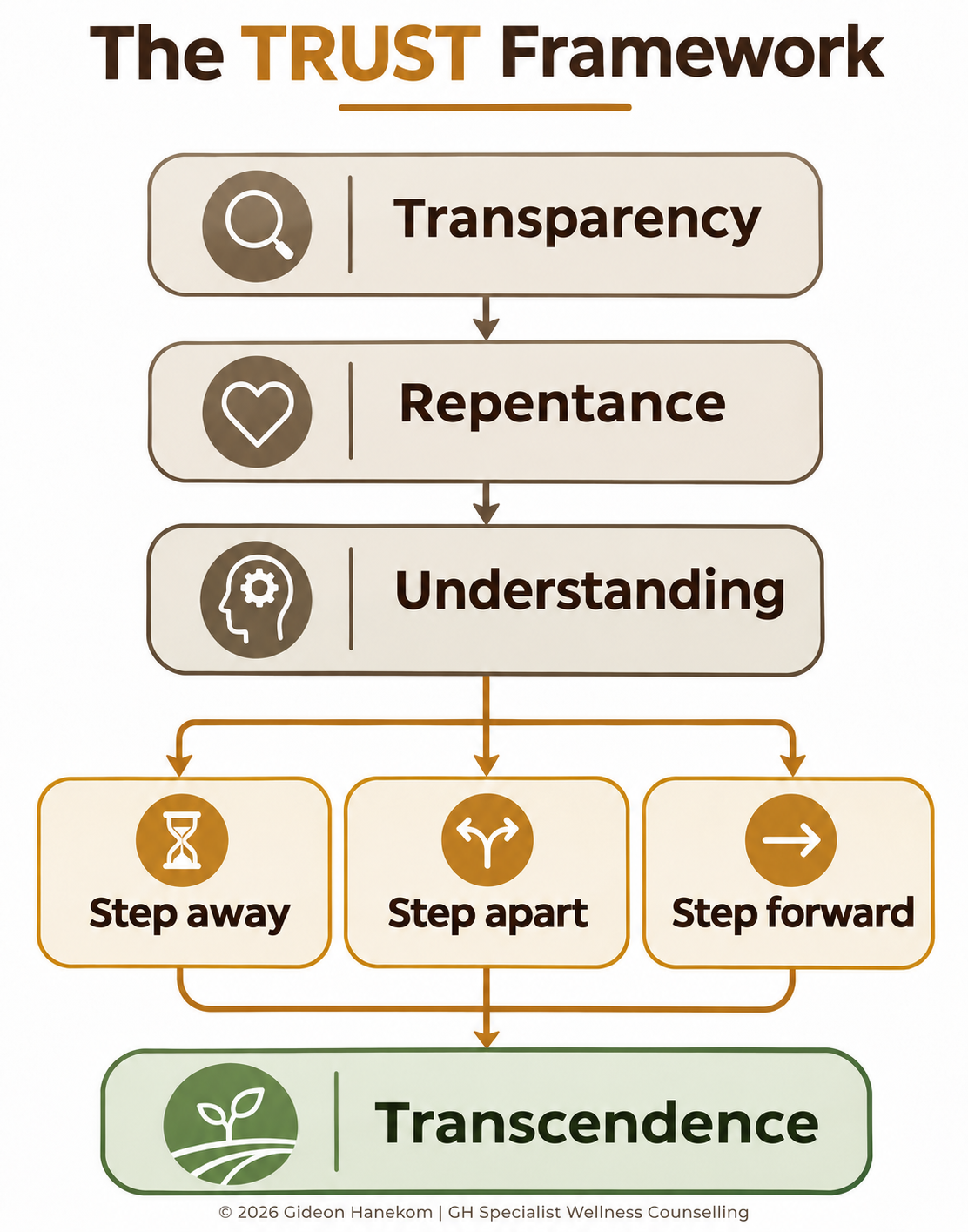
Drawing on my own life experiences, professional education, philosophical influences and years of working with people, I’ve developed a framework through which I like to approach conversations about broken trust.
I simply call it the TRUST Framework, an acronym representing five areas of conversation and personal and relational work:
- T: Transparency
- R: Repentance
- U: Understanding
- S: Step away, step apart or step forward
- T: Transcendence
Although I’ve developed this framework primarily with significant breaches of trust, such as infidelity, in mind, many of its principles are equally applicable to other relationships.
You might be dealing with dishonesty in a friendship, financial secrecy within a family or repeatedly broken promises in a relationship with someone you care about.
The nature of the betrayal may differ, but many of the underlying principles of rebuilding trust remain the same.
Interestingly, a 2025 systematic review by Giacobbi and Lalot identified several recurring elements in the research on trust repair.
These included openness, accountability, remorse, opportunities to verify behaviour, understanding the reasons for the betrayal and reconnecting through shared experiences.
What I find particularly important is that these are not isolated activities. They are interconnected parts of a larger process.
And I believe the order in which we approach them matters.
So, let’s break it down.
1. Transparency: Are you prepared to be completely honest?
Before we can begin rebuilding anything, we need to establish what it is we’re actually dealing with.
One of the particularly painful aspects of betrayal is that it doesn’t only change how someone experiences their relationship in the present. It can also change how they understand their past.
Imagine discovering that your partner had been having an affair for six months.
Suddenly, you’re not only dealing with the affair itself.
You’re mentally revisiting conversations, holidays, evenings spent together and seemingly insignificant incidents that now take on an entirely different meaning.
You’re trying to reconcile the reality you thought you were living in with the reality you’ve just discovered.
And perhaps the most unsettling question of all is whether you now know the truth or simply another version of it.
This is why transparency is so important.
Every time another piece of information emerges after you’ve supposedly been told the whole truth, you may find yourself having to revisit the entire experience.
Earlier research by Atkins and colleagues (2005) found encouraging improvements in relationship satisfaction among couples who disclosed an affair before or during therapy.
Although the sample of couples dealing with infidelity was small, the findings suggest that openness may help create the conditions in which recovery can take place.
So, if you’re the person who broke the trust, I would encourage you to reflect on a few questions before expecting the other person to begin trusting you again:
- Is there anything I’m still withholding because I’m afraid of the consequences?
- Am I volunteering information, or am I only being honest when confronted with evidence?
- Is there anything that might come to light later and undermine the work we’re about to undertake?
- What am I willing to do differently to help the other person experience a greater sense of safety with me?
Now, transparency doesn’t necessarily mean sharing every graphic or intimate detail of what happened. It might, but not necessarily.
Some information helps a person make sense of their experience, while other details may give them painful images that are difficult to forget.
Therefore, it’s worth having a conversation about what the person who has been hurt genuinely needs to know and what they’re hoping to establish through their questions.
Nor does transparency mean permanently surrendering your right to privacy.
It does, however, require a willingness to establish reasonable, mutually agreed ways of being open with each other.
Most importantly, the behaviour that broke the trust needs to stop.
That is non-negotiable.
You cannot meaningfully rebuild trust while continuing to undermine it.
But knowing the truth, although essential, doesn’t necessarily make someone feel safer with you.
They also need reason to believe that the person who made those choices is capable of making different ones.
Which brings us to repentance.
2. Repentance: Are you sorry, or are you changing?
Repentance is a word I still have a great appreciation for, despite its often religious associations.
The Greek word metanoia, associated with repentance in the Christian tradition, conveys the idea of a change of mind and thus, a change of ways.
What I particularly appreciate about this concept is the implication that a change in how we think should ultimately lead to a change in the direction of our lives.
In other words, there is a difference between feeling sorry about something and turning away from it.
You might genuinely regret having an affair.
You might feel terrible about the pain you’ve caused your partner, the consequences for your family and the possibility of losing your relationship.
But what exactly has changed in you?
This distinction is important because the person whose trust you’ve broken is not simply trying to determine whether you feel bad enough about what happened.
They’re trying to determine whether it is safe to make themselves vulnerable to you again.
The research reviewed by Giacobbi and Lalot reinforces the importance of remorse accompanied by accountability and observable behaviour.
With that in mind, perhaps there are some more meaningful questions to ask yourself than simply whether you’re sorry:
- What exactly am I sorry for, beyond the consequences of my actions?
- What attitudes, habits or behaviours am I actively changing?
- Am I willing to take responsibility for my choices without qualifying my apology with a reference to someone else’s shortcomings?
- Can I remain compassionate towards the person I’ve hurt, even when their pain makes me uncomfortable?
That last question is particularly important.
There may come a point when you feel you’ve apologised enough, answered enough questions and demonstrated enough change.
You might become frustrated when your partner brings up something you’ve discussed several times before.
But consider for a moment what your response communicates to them.
When someone asks you the same painful question for the fifth time, your ability to respond with patience and compassion might be as important as the answer itself.
In that moment, you’re demonstrating something about who you are becoming.
You are, in effect, giving them another small piece of evidence upon which they can begin rebuilding their trust in you.
This is why I see repentance as something considerably more meaningful than an apology.
Being sorry is something you feel. Repentance is something you demonstrate.
Once we have established greater honesty and a willingness to take responsibility, we can begin having a different kind of conversation.
We can start exploring why things happened without that exploration becoming an exercise in shifting blame.
3. Understanding: What happened, and what does it mean?
I think there are two equally important dimensions to understanding a betrayal.
The first involves understanding the circumstances, personal struggles, attitudes, decisions and relationship dynamics that contributed to it happening.
The second involves understanding what the experience has come to mean to the person who was hurt.
Let’s consider the first.
Perhaps there had been a growing emotional distance between you and your partner.
Perhaps there were unmet needs, unresolved conflicts, personal insecurities or conversations that should have taken place years ago.
Understanding these things matters.
If we intend to create a healthier relationship, we need to understand what made the previous one vulnerable and how the choices that led to the betrayal came about.
However, we need to be careful not to confuse an explanation with an excuse.
Two people can contribute to an unhealthy relationship climate without both being responsible for one person’s decision to have an affair.
That is an important distinction, and one of the reasons I prefer to establish transparency and repentance before exploring the broader relationship dynamics.
Without that foundation, a conversation intended to create understanding can easily become another opportunity to shift responsibility.
But understanding how something happened is only part of the work.
We also need to understand the meaning the other person has attached to the experience.
For one person, their partner’s infidelity might reinforce a deeply held belief that they’re not good enough.
For another, it might mean that something they considered sacred between them and their partner has been given away.
For someone else, it might mean that the person with whom they felt safest is no longer someone they feel safe around.
The same event can have profoundly different meanings for different people.
When someone asks, “Did you love them?”, what are they really asking?
Perhaps they’re trying to establish whether they still occupy a meaningful place in your life.
And when they ask, “How could you do this to me?”, perhaps what you’re hearing is an expression of grief rather than a request for another explanation.
A 2023 study by Fife and colleagues explored the process of healing from infidelity among couples who chose to remain together.
Their findings highlight the importance of working through the experience emotionally, taking responsibility, communicating and gradually restoring the relationship.
This suggests that healing involves considerably more than establishing the facts.
It requires us to become curious about how the other person has experienced what happened and what they’re still struggling to make sense of.
So, as you work through this part of the process, there are a few conversations worth having:
- What was happening within me that I didn’t understand, acknowledge or address at the time?
- What was happening between us that we perhaps failed to talk about?
- What has this experience come to mean to you about yourself, about me and about our relationship?
- What are you still struggling to understand?
- Knowing what we know now, what would need to change for us to create a healthier relationship?
You might find yourselves returning to these conversations repeatedly.
Understanding is rarely something we arrive at in a single conversation, particularly when we’re dealing with something as emotionally complex as betrayal.
But as you develop a clearer understanding of what happened, what it meant and what would need to change, you become better equipped to make a decision about your future.
And that decision deserves a conversation of its own.
4. Step away, step apart or step forward: What do you want now?
One of the things I believe we sometimes get wrong when dealing with broken trust is that we expect people to make decisions about their future while they’re still desperately trying to make sense of their past.
If you’ve just discovered that your partner has been unfaithful, you might feel an enormous amount of pressure to decide whether you’re going to stay or leave.
Some of that pressure might come from your partner, some from friends and family, and some from within yourself.
But how do you make an informed decision about your future when you’re still uncertain about the reality of your relationship?
This is why I see transparency, repentance and understanding as foundational work.
They help you establish what you’re dealing with, whether meaningful change is taking place and what continuing the relationship might require.
This approach is consistent with the work of Snyder, Baucom and Gordon (2008).
Their approach to affair recovery involves addressing the initial impact of the betrayal, exploring its contributing factors and meaning, and ultimately making an informed decision about moving forward together or apart.
Once you’ve reached a sufficient degree of clarity, I believe there are three legitimate directions you can take.
Step away

You might need some time and space before making a decision.
This doesn’t necessarily mean physically separating. It might simply mean removing the pressure to decide immediately.
If you choose this option, it’s worth having a conversation about what you intend to do with that time, what boundaries you need and when you’ll revisit the decision.
The idea is to create intentional space in which you can reflect, rather than simply allowing the situation to drift indefinitely.
Step apart
You might reach the conclusion that you no longer want to continue the relationship.
This doesn’t necessarily mean that the work you’ve done together has been unsuccessful.
Understanding what happened can still help you heal, make sense of your experience and, where possible, bring the relationship to a more respectful conclusion.
This can be particularly valuable when you have children and will continue to have some form of relationship with each other.
Step forward
You might both decide that there is something worth rebuilding and that you’re prepared to commit yourselves to the work involved.
But it’s important to recognise that choosing to stay together and choosing to actively rebuild a relationship are not necessarily the same thing.
The first is a decision. The second requires ongoing action.
Of course, nobody is obliged to complete this process before leaving a relationship.
Where there is ongoing abuse, coercion, intimidation or fear, safety and appropriate individual or specialist support need to take priority over joint relationship work.
You can find a list of emergency numbers to call here.
The objective of working through broken trust, as I see it, is not necessarily to save your relationship.
It is to help you make healthier and more informed decisions about your life and your relationships.
If, however, you both decide to step forward, there is another important question to consider.
What exactly are you hoping to build?
5. Transcendence: Can you build something better?
When people experience a significant crisis in their relationship, it’s understandable that they might long for things to go back to the way they were before.
But I would encourage you to think a little differently about this.
If we have spent time understanding the personal and relational dynamics that existed before the betrayal, why would we necessarily want to recreate that particular relationship?
Perhaps what we should be aiming for is something better.
I use the word transcendence because it captures the idea of moving beyond something.
In this context, it means moving beyond the versions of ourselves and the relationship dynamics that existed before the betrayal.
This is where much of the ongoing work of rebuilding your relationship takes place.
And because we’ve already spent time understanding what happened, we have a better idea of where to focus that work.
In my broader Relationship Climate Framework, I approach this through three interconnected areas.
What we bring into the relationship
Each of us brings our own experiences, insecurities, values, emotional habits and unresolved personal struggles into a relationship.
What have you learned about yourself through this experience, and what personal work do you need to undertake?
Perhaps there are things you’ve been avoiding within yourself that now need your attention.
What we create together
What kind of relationship climate do you want to create?
How can you develop a greater sense of emotional safety, friendship, affection, intimacy and mutual respect?
What boundaries and agreements need to be renegotiated to help both of you feel comfortable in the relationship you’re building?
How we interact with each other
How will you approach difficult conversations differently?
How will you communicate your needs, navigate disagreements and respond to each other’s vulnerabilities, particularly when the past resurfaces?
This last point deserves some attention because, even after considerable progress, there will probably be moments when something triggers the pain associated with the betrayal.
It might be a notification on a phone, a particular song, an unexpected change of plans or a place you happen to drive past together.
How you respond to each other in those moments becomes part of the new relationship you’re building.
In fact, these moments can become opportunities to demonstrate how differently you’re now able to relate to each other.
A 2022 study exploring the experiences of both partners following infidelity identified meaningful communication, rebuilding emotional safety and trust, and forgiveness as important aspects of recovery.
Forgiveness, however, should not become something you demand from the person you’ve hurt.
Nor should it be confused with restored trust.
Someone might choose to forgive you while still needing considerable time before they feel comfortable trusting you again.
The aim of transcendence is not to create a perfect relationship.
It is to become two people who are increasingly capable of dealing with the imperfections and challenges of being in a relationship.
Why consistency matters when rebuilding trust
Although I’ve presented TRUST as five steps, I would encourage you NOT to think of them as five boxes you need to tick before moving on with your life.
In reality, you’ll probably find yourselves revisiting several of these conversations throughout the process.
Transparency, repentance and understanding need to become ongoing characteristics of the relationship you’re trying to build.
And if you’re the person who broke the trust, there is something particularly important to understand about this process.
Your margin for error, particularly when it comes to honesty, has probably become considerably smaller.
Imagine spending six months rebuilding a sense of trust with your partner, only for them to discover that you deliberately omitted something relatively insignificant from a conversation.
From your perspective, it might seem like an overreaction when that discovery leads to another difficult conversation about trust.
But your partner is not necessarily responding to the significance of that particular omission.
They might be responding to what it represents.
Have things really changed?
Am I being deceived again?
Can I trust my own judgement this time?
This is why consistency matters so much.
You’re not simply trying to demonstrate that a particular incident won’t happen again.
You’re trying to help someone develop a different experience of being in a relationship with you.
Having said that, there is an important difference between a setback in the healing process and another breach of trust.
A difficult conversation, an emotional trigger or a day when your partner feels particularly uncertain doesn’t necessarily mean you’re back where you started.
These experiences can form part of the healing process.
Renewed dishonesty, however, can undermine the very foundation you’ve been working so hard to establish.
The distinction matters because rebuilding trust is not about becoming perfect.
It is about becoming consistently trustworthy.
So, are you prepared to do the work?
Whether you’re reading this as someone who has broken another person’s trust or as someone whose trust has been broken, I’d encourage you to spend some time considering where you currently find yourself in this process.
Perhaps you’ve been trying to rebuild a relationship without ever really establishing the truth about what happened.
Perhaps apologies have been made, but very little has changed.
Or perhaps you’ve been trying to move forward together without fully understanding what the experience has meant to each of you.
If that’s the case, it might be worth revisiting some of the foundational conversations rather than simply trying harder to move forward.
The following questions might help you establish where your next conversation needs to begin:
- Transparency: Do we have sufficient honesty and openness upon which to build?
- Repentance: Is there evidence of genuine and sustained change?
- Understanding: Do we understand both how this happened and what it has meant?
- Step away, apart or forward: Knowing what we know now, what do we actually want?
- Transcendence: If we choose to move forward together, what are we prepared to do differently?
You don’t have to have all the answers today.
But if you want to explore the possibility of rebuilding your relationship, you do need to be willing to have some honest conversations about these things.
And perhaps the most important realisation for the person who has broken the trust is that you cannot control whether someone will eventually choose to trust you again.
What you can control is whether you become someone who is worthy of that trust.
Rather than asking someone to work harder at trusting you, focus on becoming someone who is easier to trust.
If you’re struggling to navigate these conversations, I offer structured relationship counselling in which we can work through these areas together, establish where you currently find yourselves and explore what a healthy and realistic way forward might look like.
You’re also welcome to book a free initial consultation to discuss your circumstances, ask questions about the process and establish whether working together would be a good fit.
Sometimes we rebuild the house together.
Sometimes we discover that we need to build elsewhere.
Either way, it’s worth learning how to lay a better foundation.
The TRUST Framework is a research-informed wellness counselling framework of my own design. Its individual principles draw on established concepts in relationship research, counselling, personal development and philosophy. The framework as a whole has not been independently evaluated as a treatment model.
The TRUST Framework © 2026 Gideon Hanekom | GH Specialist Wellness Counselling. All rights reserved.
